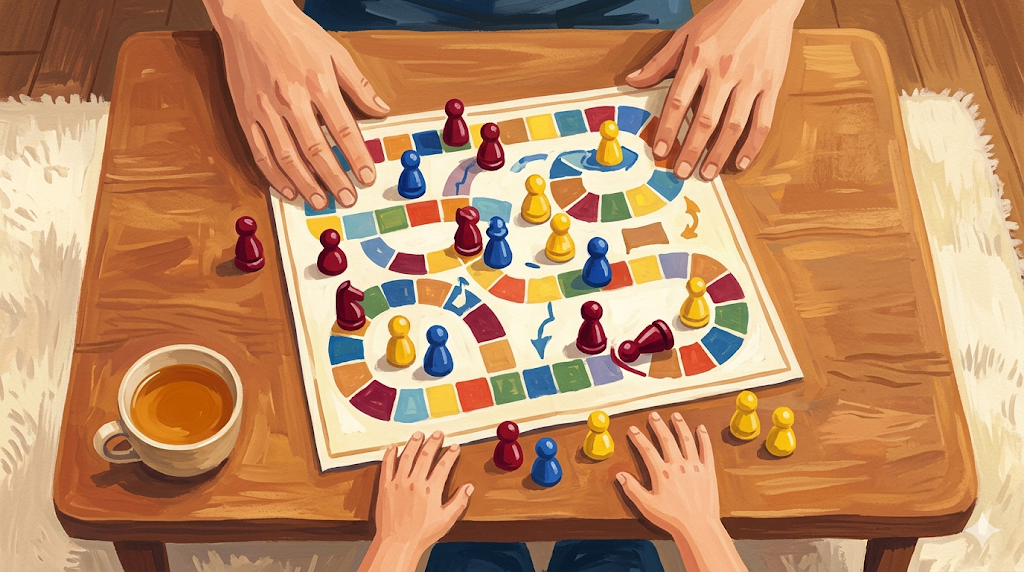
It was Ludo. Saturday evening, after dinner, pieces already sorted by colour on the coffee table.
Your 8-year-old had three pieces home. One to go. Then your piece landed on theirs and sent it back to start.
The chin went first. Then the eyes. Then the voice: "This game is stupid. I don't want to play anymore." The piece slid across the board. Your child was already standing up.
You sat with the board in front of you and felt something that is hard to name exactly. Not quite frustration. Not quite worry. Something that sits between the two, and that you have felt before because this was not the first time this week. The card game on Wednesday ended the same way.
What you are actually watching
Before anything else: the fact that you noticed matters.
This is not a behaviour problem. Your child is not choosing to fall apart. What you are watching is a capacity that is still being built the ability to feel something disappointing and stay inside that feeling without exiting it. The meltdown after the lost piece is not a character verdict. It is the evidence of a gap in a specific capacity: Emotional Regulation. And gaps in Emotional Regulation at ages 7, 8, and 9 are exactly where this capacity is supposed to be built in these moments, at this age, with a parent who understands what is happening and does not treat it as an emergency.
The falling apart is where the building happens. Not in spite of these moments. Inside them.
Research finding
"The patterns that form here become the defaults the adult brain reaches for under pressure." James Gross, Stanford University
Why the losing moment is harder than it looks
James Gross at Stanford University has spent more than three decades studying how emotion regulation develops and which strategies build lasting capacity.
His research distinguishes between two types of regulation: strategies that work before an emotion peaks before the piece goes back to start, before the result is announced and strategies that try to manage the feeling after it has already arrived. The first type, which he calls antecedent-focused regulation, builds durable capacity. The second type is working against a wave that has already broken.¹
What this means for your 8-year-old is precise: by the time the piece slides back to start, the window for easy regulation has already closed. The feeling is already at full height. A child whose brain has a practiced route into that moment, something specific and owned, built before the game starts, can find it. A child whose brain has no route exits the feeling instead, because exiting is the only option available.
The meltdown is not the problem to solve. The absence of a route is. And routes are built before they are needed.
One practice. Tonight. Five minutes.
Before the next game, not during it, not after it, sit down with your child and say this:
"Someone is going to lose this game. Let's decide now what we'll do when that person is us."
Then go first yourself. Name one specific thing. Not something abstract like "I'll be gracious." Something physical and completable:
"I'm going to say 'good game' and put my hand out."
Or: "I'm going to take two slow breaths and help tidy up the pieces."
Then ask your child: "What's your one thing?"
Whatever they say, receive it without improving it. If it's "I'm going to get some water" that's their thing. It doesn't need to be noble. It needs to be theirs.
Then play the game. When the losing moment arrives and it will, say nothing. If the thing happens, name it quietly afterward, without ceremony: "You did your thing." Not a big deal. Just the noticing.
If the meltdown comes anyway, let it pass. Don't reference the plan while the feeling is still at height. Before the next game, ask again: "What's your one thing?"
What you are building is a child whose brain has something to reach for in the moment before the peak. The plan does not have to work every time. It has to exist. Its existence is what makes it available when the feeling arrives faster than the thinking.
What the child carries forward
When your child names their thing before you ask - the practice is working.
After six weeks of this, your child does not necessarily win gracefully every time. What changes is the half-second before the collapse: the brain checking for the route and finding it.
That pause is not visible to anyone else watching the game. But you will know it. You will see the chin go and then see your child say "good game" through whatever feeling is still present. Not because the feeling has passed. Because they have somewhere to put it.
Over time, across losing at sport, at school, in the small daily defeats that a full life produces, that pause becomes the child's own. They stop needing the pre-game ritual because the route is already there. Built before it was needed. Available when it matters.
That is what a strong mind does with a hard feeling. It does not feel less. It knows what to do with what it feels.
Strong mind. Ready for anything. Built at home. Together.
Neurry generates one question like this every day, calibrated to your child's exact age. neurry.com
Common questions parents ask about this
My 8-year-old cries and throws things every time they lose, even at simple card games. Is something wrong?
Nothing is wrong. Between ages 7 and 9, the capacity to stay inside a disappointing feeling without exiting it is actively forming. The strength of your child's reaction is a signal about the gap in that capacity, not about their character. Most children this age have not yet built a practiced route for the losing moment. The work is to build one deliberately, before it is needed.
What do I actually say when my child falls apart after losing?
In the moment itself, very little. The feeling is already at full height and reasoning does not reach a child at that point. Let the feeling pass. Later, before the next game, sit with them and ask: "Someone is going to lose this game. What's your one thing, what will you do when that person is us?" You go first. Model your own specific answer. Then receive theirs without improving it. That conversation, done before the game, builds more than anything said during the meltdown.
Why does my 7-year-old react so strongly to losing when other children seem fine?
Children this age vary significantly in how much emotion regulation capacity they have built so far. Some children have had more early experience of managing small losses and disappointments; others have been rescued from those moments more consistently, which means the capacity hasn't had the chance to form. Neither produces a different kind of child, just a child at a different stage of building the same capacity. The building is available now.
If my child can't handle losing at 8, will they struggle with setbacks when they're older?
The pattern you're watching does not set itself if it goes unaddressed. The research is clear that the regulation patterns forming between 7 and 9 tend to become defaults, the routes the brain reaches for automatically under pressure in adolescence and beyond. This is precisely why this age is when the building matters most. Six weeks of consistent practice before games builds more durable capacity than any amount of encouragement delivered during a meltdown. The window is open. The work is specific and doable.
My child falls apart when they lose but also when a drawing doesn't come out right, and when they're not chosen first. Are these the same thing?
Yes. What connects them is a single underlying capacity: the ability to stay inside a disappointing or frustrating feeling without immediately exiting it. The board game, the drawing, the not being chosen, these are different triggers for the same gap. The practice described here builds the capacity at the root, not the response to any one trigger. As the capacity strengthens, you will notice it beginning to show up across all three situations. Neurry's daily practice is built around exactly this kind of capacity work, one named trait, built in five minutes a day. neurry.com
Sources
1. Gross, J.J. (1998). Antecedent- and response-focused emotion regulation: Divergent consequences for experience, expression, and physiology. Journal of Personality and Social Psychology, 74(1), 224–237.
https://pubmed.ncbi.nlm.nih.gov/9457784/