Book 2 · Age 5
Book 2 Tell stories
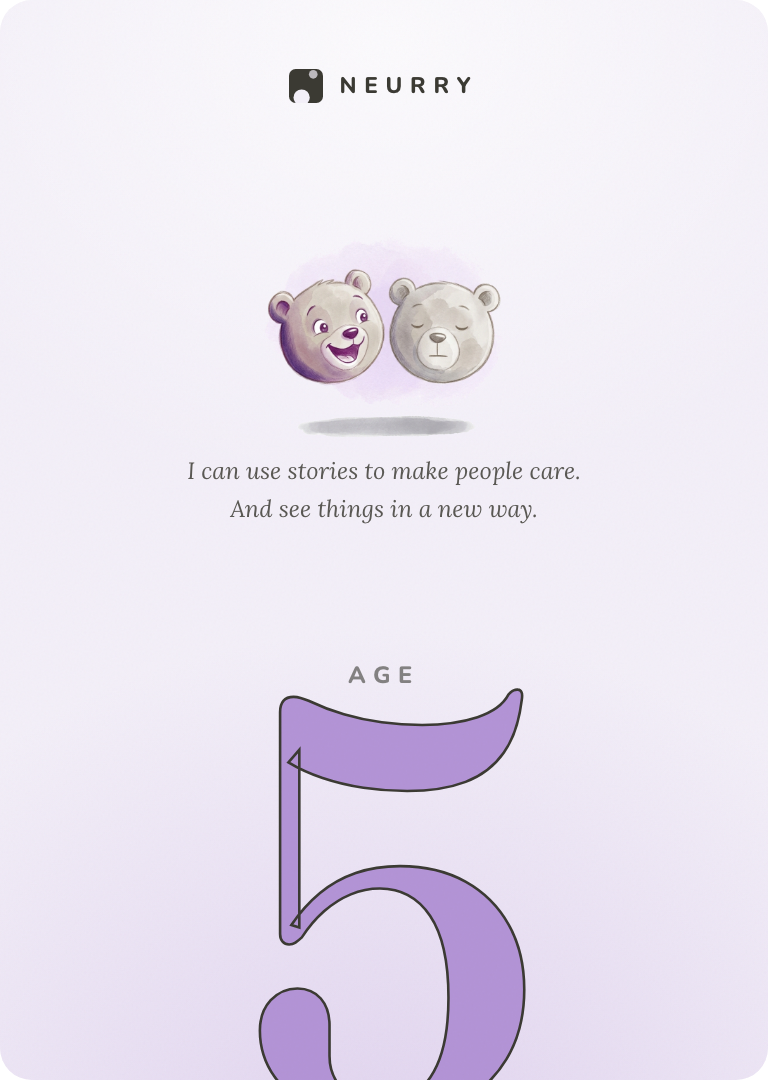
I can use stories to make people care
3 volumes A year of telling stories
- Volume 1
- Volume 2
- Volume 3
Book 2 Tell stories
I can use stories to make people care
3 volumes A year of telling stories
Your child makes things up all day.
A creature. A place that could not be real. A story about the dog.
At age 5, children make stories.
This book turns the making into telling, until your child tells one whole story, and watches you feel the story.
At dinner, your child begins, “Once there was a tiger who lost his roar,” and the whole table turns to hear.
A play a day, made for you and your child.
Each play is one real making: a creature, a place, a story about the dog and what the dog wanted. Your child makes the story, then shapes, then tells, until your child tells a whole story to someone who was not there.
We do not grade a story, and we do not keep score of the making. The strange stays. The impossible stays. What grows is the telling.
A strong mind is raised at home, a little each day, by you. You give the time, and quiet. Your child does the hard part. Together, we raise the mind.
One play. You read a short setup out loud, your child does one real thing with it, and the day ends on a question. Nothing to print, nothing to prepare, nothing to buy.
Play is already good for your child, and this does not replace it. A play is aimed: each day works one capacity, in an order built across the year, so the practice adds up instead of scattering. You keep the playing. The book adds the aim.
Some plays will not land, and a refusal costs nothing. Leave the play and come back another week, or move on. The book is not a schedule with a debt attached, and a play your child refuses in March often works in May.
Yes, and the design assumes a tired parent at the end of a long day. A play is short, needs nothing set up, and asks you to stay close rather than to perform or teach. Your calm is the whole method, and five minutes of calm is a fair ask.
The plays are written for where a five year old actually is, so both ends work with a small adjustment. A young five needs more of you inside each play. A child near six moves through the same ground faster, and the later cycles will still stretch them.
The book waits. Nothing expires, and nothing needs catching up. You pick up where the two of you stopped, and the practice already laid down holds.